

Brand messaging library
Sustainability claims are complex, and subject to changing legislation. Our brand messaging library will help you communicate about B Corp certification with confidence. The library contains messaging of varying lengths for flexible use on a variety of platforms and formats.
All the copy you’ll find in this section has been reviewed for compliance with the Empowering Consumers for the Green Transition (ECGT) Directive, which aims to prevent greenwashing and help consumers make sustainable purchasing decisions. Our goal is to help you make claims that are both compelling and compliant.
However, it is the responsibility of Certified B Corps to ensure that your use of the B Corp logo and taglines comply at all times with laws and requirements relating to sustainability claims. The following guidelines do not constitute legal advice, or an approval of each use case of the B Corp logo.
Only these claims are approved for use alongside the B Corp logo and IP.
How to use this library
-
For use on pack, advertising, and other space-constrained formats.
-
One sentence for use on short-form content like social media and digital subheads.
-
Additional description for use in longer-form prose, including following the tagline or short copy in digital settings (such as websites).
-
Objective proof points that support each claim, taken from research findings or specific requirements in the B Lab Standards. These may accompany related claims to strengthen and tie them to evidence.
-
The messaging is divided into suitable for all B Corps, suitable for those certified on V1.6, or those certified on V2.1 onwards (Year 0).
Core brand messaging
Suitable for all
What is a B Corp?
Certified B Corporations™, or B Corps™, are companies verified as meeting standards for social and environmental performance, transparency, and accountability.

What does the “B” stand for?
B stands for “benefit”—for people and the planet, not just shareholders.
Brand taglines
Suitable for all
Part of a global movement working to benefit people and the planet.
This company meets verified standards for social and environmental business practices.
How do I speak about being a B Corp?
Suitable for all
The following messaging will help you communicate about being a B Corp, based on three key principles of our certification.

1. B Corp certification is integrated
-
[This company] meets B Lab’s integrated social, environmental, and governance standards.
-
[This company] meets B Lab’s integrated social, environmental, and governance standards.
This embeds our purpose and plans for positive impact in our company DNA, so that we’re aware of our impact on people and the planet.
-
B Corps are 3.1 times more likely to measure their social and environmental performance through defined KPIs, compared to ordinary businesses (B Lab Global 2024 Annual Report, published 2025).
B Corps are 3.7 times more likely to embed social and environmental goals in key decisions, compared to ordinary businesses (B Lab Global 2024 Annual Report, published 2025).
B Corps are 2.6 times more likely to hold managers accountable for mission alignment (B Lab Global 2024 Annual Report, published 2025).
B Corps are 1.6 times more likely to have Boards of Directors composed of majority women or individuals from other underrepresented populations, compared to ordinary businesses (B Lab Global 2022 Annual Report, published 2023).
NEW! For B Corps on V2.1 onwards:
B Corps are required to establish a public purpose to make a meaningful positive impact (B Lab Standards PSG1.1)
B Corps are required to have the highest governing body monitor the company's purpose, social and environmental impact, and stakeholder considerations (B Lab Standards PSG5.2).
2. B Corps are part of a collective

-
Part of a global movement using collective action to work towards a more inclusive, equitable, and fair economy.
-
As a Certified B Corporation, we’re proud to be part of a community of companies working together for change, and taking part in collective action to advocate for a shared goal of a global economy that benefits people and the planet.
-
There are now over 10,000 B Corps globally, which together provide over 1 million jobs (B Lab Global (2022) B Impact Assessment version 1.6).
B Corps are 2.7 times more likely to perform policy advocacy for social and environmental standards by providing active staff time or financial support, compared to ordinary businesses (B Lab Global (2022) B Impact Assessment version 1.6).
NEW! For B Corps on V2.1 onwards:
B Corps are required to have a public policy on responsible lobbying (B Lab Standards GACA1.1).
B Corps are required to publicly share their lobbying positions and political contributions each fiscal year (B Lab Standards GACA1.2).
3. B Corp certification is credible

-
B Corps are verified on credible social and environmental business practices.
-
Our business practices are certified on environmental, social, and governance standards.
We strive to be transparent and accountable for our impact, and adapt our practices to reflect evolving social and environmental issues—aligning with consumer demands and values.
-
Consumers under 40 are more likely to know the B Corp brand. In the US, for example, half of consumers under 25 are aware of B Corps (B Lab (2024) B Corp Brand Awareness Report).
85% of those aware of B Corp Certification say it influences their purchasing decisions (B Lab (2024) B Corp Brand Awareness Report).
90.7% of consumers believe company directors should be accountable for social and environmental performance (B Lab European Brand Awareness Study).
B Corps are 3.1 times more likely to measure their social and environmental performance through defined KPIs, compared to ordinary businesses (B Lab Global 2024 Annual Report, published 2025).
B Corps are 3.7 times more likely to embed social and environmental goals in key decisions, compared to ordinary businesses (B Lab Global 2024 Annual Report, published 2025).
We have been certified as a B Corp by SCS Global Services, a leader in third-party certification that also verifies FSC®, USDA Organic, and many Fortune 500 companies.*
NEW! For B Corps on V2.1 onwards:
B Corps are required to report their progress annually in an impact report (B Lab Standards PSG2.4).
B Corps are required to establish a public purpose to make a meaningful positive impact (B Lab Standards V1.6, and V2.0 PSG1.1).
*Medium or larger companies only
For additional languages that are not available in the B Corp Brand Book website, please find Taglines and Short Copy appendix PDFs here.
Communicating the standards
Suitable for V1.6
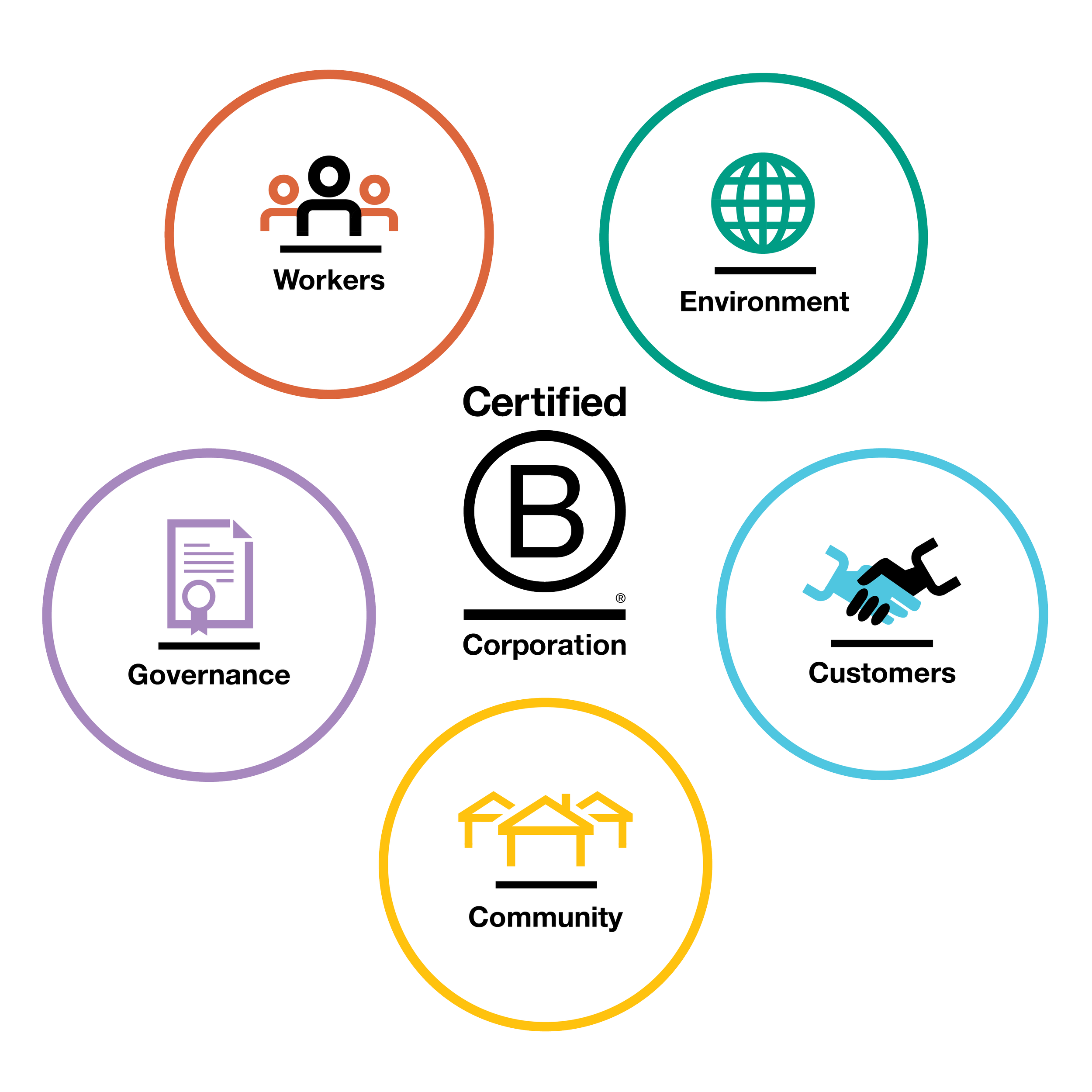
For B Corps still certified on V1.6, use our prompts for the five Impact Area Pillars to guide your communication.
Environment
How is your company prioritizing and taking care of the planet?
Governance
How do you make sure your company’s governance considers all stakeholders?
Customers
How is your company having a positive impact in your customers’ lives?
Community
How is your company giving back and contributing positively to the community?
Workers
How is your company taking care of your workers, improving their lives and wellbeing?
A notice was added to B Lab's website in February 2024 to respond to questions in some markets about the nature of B Corp Certification, specifically: Is B Corp Certification issued or endorsed by a government entity?
As of May 6, 2024, all B Corps with operations in Italy must place this disclaimer on their websites in the section where the B Corp status is first disclosed.
Suitable for V2.1 onwards
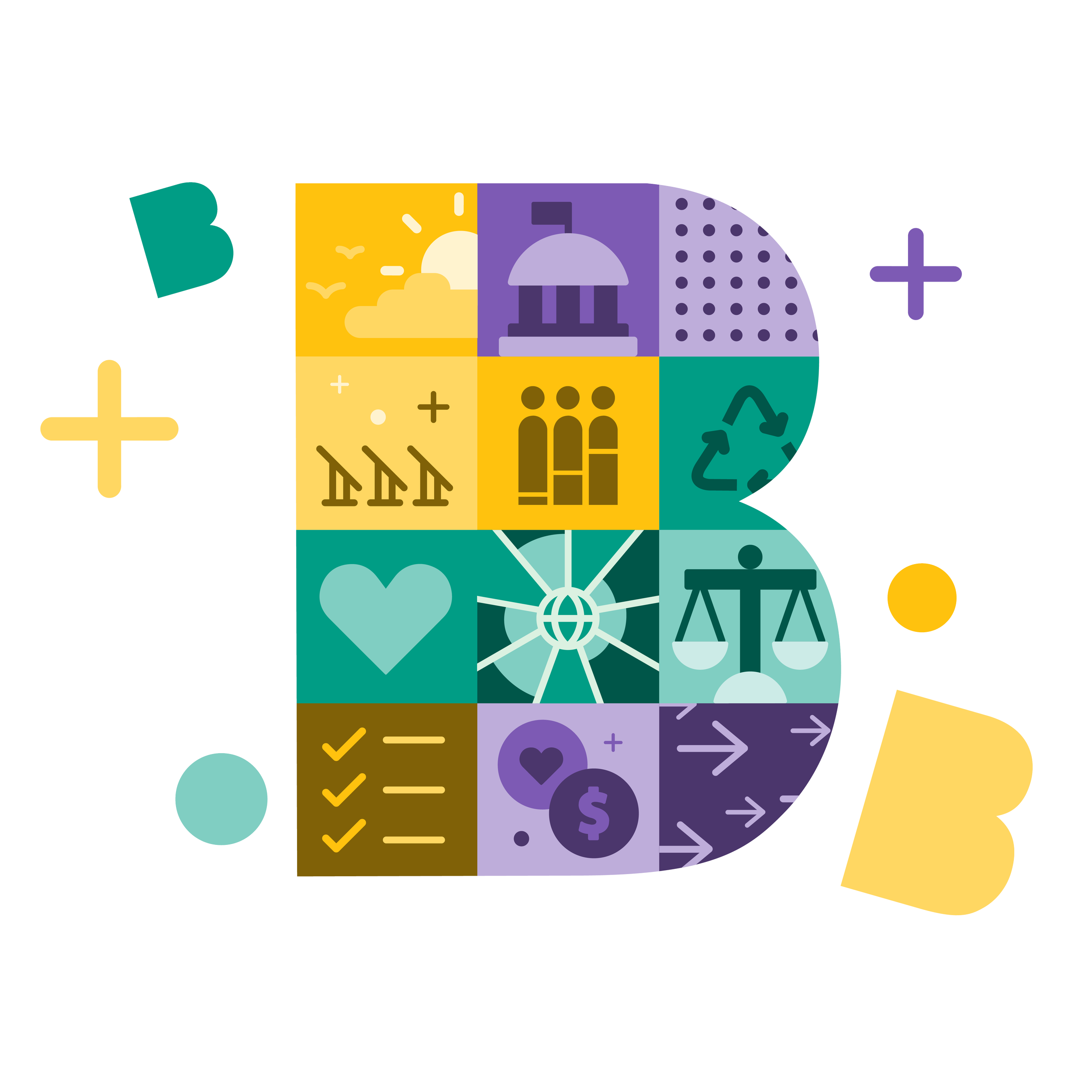
The B Lab Standards V2 require businesses to take meaningful action across seven key social, environmental, and governance Impact Topic areas. The following messaging allows all B Corps certified on V2.1 onwards to communicate clearly with consumers what they achieve in these areas.
They can only be used by B Corps that have certified on the new version of the standards, in 2026 or later (V2.1 onwards, Year 0).

Climate Action
-
Taking action on the climate crisis
-
Working to be part of the solution by taking actionable steps to address the climate crisis.
-
We see acting on the climate crisis as a business necessity.
[This company] is identifying key areas within our operations and value chains to improve, and using a climate action plan to track progress.
-
B Corps in developed markets are 8.1 times more likely to have offset 100% of their GHG emissions than ordinary businesses in developed markets (B Lab Global (2022) B Impact Assessment, version 1.6).
B Corps are 4.5 times more likely to use 100% renewable energy than ordinary businesses (B Lab Global (2022) B Impact Assessment, version 1.6).
B Corps are 2.7 times more likely to design packaging with reduced environmental impact, than ordinary businesses (B Lab Global 2024 Annual Report, published 2025).
B Corps are 3.1 times more likely to measure their social and environmental performance through defined KPIs, compared to ordinary businesses (B Lab Global 2024 Annual Report, published 2025).
NEW! For B Corps on V2.1:
Large, X Large, and XXL B Corps are required to have a documented process to measure Scope 1, 2, and 3 GHG emissions annually and disclose the results publicly (CA1.1).
B Corps are required to have a publicly available climate action plan (B Lab Standards CA2.1: applies to Companies without Workers; Micro; Small; and Medium companies in Years 0, 3, and 5).
B Corps are required to make science-based targets, validated by the SBTi or verified by an independent third party, to make a just contribution to the global goal of net zero greenhouse gas emissions by 2050 (B Lab Standards CA2.2: applies to Large, Extra Large, and Extra Extra Large companies in Years 3 & 5).
B Corps are required to create a climate transition plan to make a just contribution to the global goal of net zero emissions by 2050 (B Lab Standards CA2.3: applies to Large, Extra Large, and Extra Extra Large companies in Years 3 & 5).
B Corps are required to make progress on their climate action plan and evaluate its effectiveness (B Lab Standards CA3.3: applies to Companies without Workers, Micro, Small and Medium companies in Years 3 & 5; and CA3.4: for Large, Extra Large, and Extra Extra Large companies in Year 5).

Purpose & Stakeholder Governance
-
A purpose-led business for people and planet
-
We live by a clear and meaningful purpose that promotes a positive impact, and we consider the interests of all stakeholders — not just shareholders.
-
We live by a clear and meaningful purpose that promotes a positive impact, and we consider the interests of all stakeholders — not just shareholders.
Our corporate purpose is what guides us, and we consider it when making business decisions. We use frameworks to make sure our stakeholders (including workers, customers, suppliers, the environment, local communities, and investors) are represented fairly.
-
B Corps are 3.1 times more likely to measure their social and environmental performance through defined KPIs, compared to ordinary businesses (B Lab Global 2024 Annual Report, published 2025).
B Corps are 3.7 times more likely to embed social and environmental goals in key decisions, compared to ordinary businesses (B Lab Global 2024 Annual Report, published 2025).
B Corps are 2.8 times more likely to publish their impact reports for public accountability, compared to ordinary businesses (B Lab Global 2024 Annual Report, published 2025).
B Corps are 2.2 times more likely to train employees on achieving impact goals, compared to ordinary businesses (B Lab Global 2024 Annual Report, published 2025).
B Corps are 2.9 times more likely to have their board of directors review key performance indicators on the company’s social or environmental performance, compared to ordinary businesses (B Lab Global (2022) B Impact Assessment, version 1.6).
NEW! For B Corps on V2.1:
B Corps are required to establish a public purpose to make a meaningful positive impact (B Lab Standards PSG1.1).
B Corps have a mechanism to consider or involve stakeholders and represent their interests in decision-making (B Lab Standards PSG2.1).
B Corps have a stakeholder governance policy (B Lab Standards PSG2.2).
B Corps are required to have the highest governing body monitor the company's purpose, social and environmental impact, and stakeholder considerations (B Lab Standards PSG5.1).

Environmental Stewardship & Circularity
-
Working towards a smarter use of nature’s resources
-
B Corps are committed to understanding our environmental impact, including taking action to address negative impacts in order to contribute to an economy that preserves our natural resources.
-
We take responsibility to understand our environmental impact, and take action to address negative impacts in order to contribute to an economy that preserves our natural resources.
As a company, we take responsibility for our environmental footprint by monitoring our waste, water, and energy use, and prioritizing responsible procurement practices.
-
B Corps are 2.4 times more likely to have programs to reduce their end of life waste compared to ordinary businesses (B Lab Global 2023 Annual Report, published 2024).
B Corps are 2.5 times more likely to have policies that require using a low carbon transportation option compared to ordinary businesses (B Lab Global 2023 Annual Report, published 2024).
B Corps are 1.5 times more likely to produce zero waste to landfill or ocean compared to ordinary businesses (B Lab Global 2023 Annual Report, published 2024).
NEW! For B Corps on V2.1:
B Corps are required to monitor waste production from their operations and where it ends up (B Lab Standards ESC1.1).*
B Corps are required to monitor their energy use (B Lab Standards ESC1.2).*
B Corps are required to monitor their water consumption or withdrawal (B Lab Standards ESC1.3).*
B Corps assess the potential negative environmental impacts related to potential organizational clients and projects, and take necessary mitigation actions (B Lab Standards ESC2.6: applies to companies under Service with Minor Footprint sector).
B Corps assess the potential negative environmental impacts of investments, and take necessary mitigation actions (B Lab Standards ESC2.7: applies to companies under Service with Minor Footprint sector).
B Corps consider the actual and potential environmental impacts of procurement decisions (B Lab Standards ESC5.1 and ESC5.2).
B Corps work with suppliers to prevent or mitigate their most material environmental impacts (B Lab Standards ESC5.3: applies to Large, Extra Large, and Extra Extra Large companies in all sectors except Service with Minor Footprint).
*Excludes service with minor environmental footprint

Human Rights
-
Committed to respecting human rights
-
We treat people with dignity and respect human rights, taking due diligence seriously on how our business and operations impact people.
-
We treat people with dignity and respect human rights, taking care to reduce harm caused by our company.
This company takes due diligence seriously, and we keep our eyes open to any negative impacts our businesses could have. We’re mindful of how our business impacts people — not just employees — and this responsibility is embedded in our culture and ways of working, including a commitment to continuous learning and improvement.
-
B Corps are 49% more likely to give customers access to information about sourcing of suppliers, including their location, compared to ordinary businesses (B Lab Global (2022) B Impact Assessment, version 1.6).
Micro and small B Corps can strengthen their human rights due diligence with a dedicated guide from B Lab and Fair Trade International.
NEW! For B Corps on V2.1:
B Corps are required to commit publicly to respecting human rights (B Lab Standards HR1.1).
B Corps are required to have a public human rights policy (B Lab Standards HR1.2).

Fair Work
-
Building fair workplaces and good jobs
-
B Corps create workplaces where all employees can thrive, through quality jobs and positive workplace culture.
-
We are building a workplace culture that values, empowers, and listens to employees—because when workers thrive, companies do too.
To help our workers thrive, we provide good quality jobs and formal frameworks that encourage feedback from workers on decisions that affect them. This helps build an engaged and satisfied workforce that is more likely to contribute meaningfully to our company’s purpose, and ultimately, to a more equitable economy.
-
B Corps are 1.8 times more likely to conduct pay equity analyses and implement fair compensation plans compared to ordinary businesses (B Lab Global 2024 Annual Report, published 2025).
B Corps are 2.7 times more likely to have processes in place to provide input from employees prior to operational and/or strategic policy or practice changes compared to ordinary businesses (B Lab Global (2022) B Impact Assessment, version 1.6).
B Corps are 36% more likely to allow workers to freely associate and bargain collectively for the terms of their employment compared to ordinary businesses (B Lab Global (2022) B Impact Assessment, version 1.6).
81.5% of B Corps already pay 100% of their employees an individual living wage, while 70.2% of B Corps pay 100% of employees a family living wage (B Lab (2025) Good Jobs Global Report), published 2025.
B Corps with policies encouraging internal promotions report that more than 15% of employees were promoted in the last year, and actively facilitate external professional development compared to ordinary businesses (B Lab (2025) Good Jobs Global Report, published 2025).
NEW! For B Corps on V2.1:
All B Corps must tell workers how they set their wage, and what benefits they are entitled to (B Lab Standards FW2.2).

Government Affairs & Collective Action
-
Mobilizing the power of the collective
-
We collaborate with others in our community to make a positive impact and drive systemic change—beyond what we could achieve alone.
-
We work with others in our community to amplify our social and environmental impacts in ways that would be impossible alone. By joining forces with others, we can combine our expertise and resources and increase the impact and credibility of our actions.
Contributing to these communities through collective action and responsible lobbying helps us to act beyond our own interests, and push for systemic change and a fairer economic system.
-
B Corps are 2.9 times more likely to perform policy advocacy for social and environmental standards by directly introducing, testifying, making recommendations or providing expertise to advance standards, compared to ordinary businesses (B Lab Global (2022) B Impact Assessment version 1.6).
B Corps are 2.7 times more likely to perform policy advocacy for social and environmental Standards by providing active staff time or financial support, compared to ordinary businesses (B Lab Global (2022) B Impact Assessment version 1.6).
B Corps are 2.4 times more likely to donate more than 1% of their revenue to charity compared to ordinary businesses (B Lab Global (2022) B Impact Assessment version 1.6).
NEW! For B Corps on V2.1:
B Corps are required to have a public policy on responsible lobbying (B Lab Standards GACA1.1).
B Corps are required to publicly share their lobbying positions and political contributions each fiscal year (B Lab Standards GACA1.2).
B Corps publicly share their lobbying positions and political contributions each fiscal year (B Lab Standards GACA1.3, applies to Companies without Workers, Micro, Small, and Medium companies, from Year 3).

Justice, Equity, Diversity & Inclusion
-
Building equity and justice into the workplace
-
Committed to an inclusive workplace and embedding equity and justice into how we operate.
-
In order to intentionally create a more equitable workplace, we take actions like inclusive hiring practices, meeting accessibility standards, and promoting diversity among suppliers.
We listen closely to our people and encourage feedback, then use what we learn to create plans to better live by JEDI principles—boosting innovation, satisfaction, and trust in our business. -
B Corps are 4.5 times more likely to have supplier diversity programs supporting underrepresented populations, compared to ordinary businesses (B Lab Global 2024 Annual Report, published 2025).
B Corps are 1.6 times more likely to have Boards of Directors composed of majority women or individuals from other underrepresented populations, compared to ordinary businesses (B Lab Global 2022 Annual Report, published 2023).
NEW! For B Corps on V2.1:
B Corps with at least 10 workers are required to facilitate a discussion or survey about JEDI principles in the workplace, in order to gather feedback on diversity and inclusion that can be used to shape JEDI actions (B Lab Standards JEDI1.1).